Islam for Universal Harmony

Friday, 17 November 2017

The Elephant Troops and Their Invasion of Kabah, A Momentous Incident before Muhammad's Birth

Before Muhammad was born, there was a momentous incident.

At the end of February 571 AD, six thousand troops came to destroy Mecca.  This army was led by Abrahah ibn Ash-Shabbah al Habasyi one of the rulers of Yemen. Abrahah was eager to tear down the Ka’bah. Why would he do that?

Abrahah was a Christian. He was annoyed since many people came to Ka’bah to do worshipping (although the practice had already been astray from the actual sharia of Prophet Abraham – people worship the idols surrounding the Ka’bah). Abrahah hated this fact. To attract people’s attention he tried to build a big tall gold-layered church at Shan’a to challenge the popularity of Ka’bah. However, it didn’t work as he planned.
Abrahah got more outraged after one night he found out a man from Bani Kinanah broke into his church and put camel’s manure on the walls at the central orientation of the church. He thus initiated to destroy Ka’bah with his elephant troops. Equipped with six thousand troops and 9 to 13 elephants, Abrahah was extremely assured of being able to tear down the Ka’bah. With his arrogance, he led his troops.
The citizens of Mecca heard the news. They anticipated the danger by escaping to the hills and mountains to avoid the attack. Mecca was like a dead town at that time. Not a single citizen stayed.
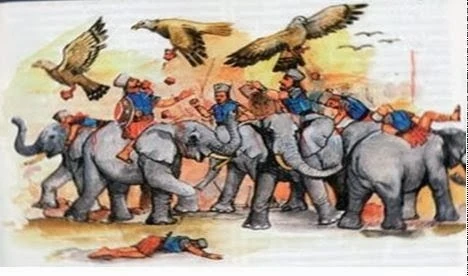
The elephant troops got nearer to Mecca. However, at the place between Muzdalifah and Mina, a strange thing happened. The 13 elephants suddenly stopped. They sat on the sand instead. These elephants would not walk to Kabah. Every time they are commanded to go to the south, north, and east, they got up and go. However, when ordered to go to Kabah, they wouldn’t do it.

Abrahah and his troops wondered this incidence. All of sudden, a flock of birds appeared on the sky. These birds (called birds of 'Ababil' - sent down by Allah) sounded so loudly that made Abrahah and his troops shut their ears. Without any prediction before, the birds dropped burning stones onto them. The stones were originally from the hell-fire. You can imagine that. They were scattered and tried their best to escape from the situation.
Every bird dropped three stones: one from their beaks and two from their legs. If the stones touch a man, the man’s will surely get holes like leaves eaten by caterpillars. Not everyone was stoned to death; some of them tried to escape but due to the great number of the troops, they squeezed each other and fell down. They were then stepped by their own friends who were also trying to run away.
Abrahah made it to escape to Shan’a. However, at the end, he suffered a strange disease. He felt his body joints were falling apart. He was just like a bird whose chest got split and his heart stood out and he finally died.

A Romatic Love Story - Ali ibn Abi Thalib and Fathimah bint Muhammad Rasulullah PBUH

source: eramuslim


There was a deep secret within Ali's heart that he would never speak to anyone. It was Fathimah; his childhood fellow, Prophet Muhammad's beloved daughter. Day after day, she looked more astonishing. Her piousness, her worship to Allah, her handiness, her looks, everything. When Rasulullah came home with wounds on his body and head full with camel's waste, she cleaned them up and wiped them carefully with her love. She burnt cloth and put it on the wounds to stop her father's blood.

Seeing what Fatimah had done, Ali couldn't understand what he felt. He felt amazed and astonished and he didn't know the name of the feeling; what he really knew was he got shocked when he heard Fatimah was being proposed by one of the best friends of Rasulullah, Abu Bakr Ash-Shiddiq. Ali realised the meaning of Abu Bakr for Rasulullah's struggle for da'wah. Some great people like Utsman, ‘Abdurrahman ibn ‘Auf, Thalhah, Zubair, Sa’d ibn Abi Waqqash, and Mush’ab became Islam because of him. It was something that was hardly done by a kid like Ali.
Look how many slaves were set free by Abu Bakr;Bilal, Khabbab, Yassir's Family, ‘Abdullah ibn Mas’ud. Financially, he felt he was nothing compared to Abu Bakr who was a successful businessman. Abu Bakr certainly could make Fathimah happier than he would.
Ali could do nothing but let her proposed and married by Abu Bakr for the sake of Fathimah's happiness.
Love never asks for any longing. It takes a chance or leaves it. It is a bravery or sacrifice.
Abu Bakr's proposal was in fact rejected. Having heard this news Ali's motivation was just burnt to prepare himself to marry Fathimah. However, his struggle was then in vain after he heard another man, a strong heroic dauntless man, with the coming of whom into Islam made the struggle of da'wah easier and made Islam much stronger than ever: Umar ibn Khattab. Al Faruq, a man of division between the truth and falsehood. He came to Islam 3 years after Abu Bakr and Ali, but who can underestimate his sincerity and totality in defending Islam? who can argue about the position of Umar in the eyes of Rasul? He was just another best friend of the Prophet. Ali once again realised his position and let Fathimah proposed and married by Umar. Umar deserved this.
Ali once again got shocked. Abu Bakr and Umar were rejected. What could he possibly do then? What kind of person was actually wanted by Rasulullah to marry his daughter?
Was it in the calibre of the billionaire Utsman? He had totally lost his confidence. All at once.
"Why don't you try, my friend?" his Anshar friend asked, "I have a sort of feeling that you are the person Rasullah is actually waiting for."
"Me?" Ali was unsure.
"Yes."
"You know I'm just a poor young man. What could I probably do?" Ali said.
"We are after you with full support, fellow. May Allah help you."
Ali determined to meet Rasulullah to ask for permission and blessing to marry Fathimah. He only had one armour and certain amount of wheat. Yes only those were what he had and he determined to marry Fathimah. Should he ask Fathimah to wait for him any longer? For about 2 or 3 years while he tried to prepare everything? Of course not! Ali was a true gentleman. Impossible he did that.
When he came to meet Rasulullah, he was welcomed by an answer of "Ahlan wa Sahlan".
Ali was confused by this answer. He didn't know whether he was accepted or refused. He decided to ask his friends.
"How did Rasulullah answer you, Ali? Were you accepted?"
"I don't know."
"What do you mean?"
"Do you think 'Ahlan wa Sahlan' means any answer?"
"How fool! Stupid!" they said. "Ups.. sorry. We meant that one answer is just enough. And you got two! Ahlan is enough and you got Sahlan too. Both of them mean YES!"

Ali married Fathimah with armour as the dowry.
With his bravery and sincerity, Ali was a true young man of integrity. 
Rasulullah said: “Indeed, Allah Azza wa Jalla ordered me to marry Fatimah daughter of Khadijah with Ali bin Abi Thalib, so bear witness that I have married them with four hundred Fidhdhah (in the value of silver), and Ali has accepted this.”
Rasulullah saw. prayed for both Ali and Fathimah:
“May Allah gather the perfections of you both, please you both, and bless you both and take out of you both much goodness.” (kitab Ar-Riyadh An-Nadhrah 2:183, chapter 4).

Wednesday, 15 November 2017

Hindu Temple-Like Muslim Minaret and the Rareness of Beefs in Kudus, Central Java, Indonesia: A STORY BEHIND A HIGH INTERFAITH TOLERANCE

By: Sigit Mukti Nugroho

Majority of people in the west see Islam as a religion with threat to unity. Islam is mostly viewed as a religion identical with terrorism due to most media reports. Majority of people in the world see Muslims as orthodox religious believers who are so strict, militant, extreme, often have no respect to the country they live. Islam is viewed to be spread by sword, sometimes they are also claimed to always condemn those who are different from them. The worst is of course by violent actions.
The very different fact about the way of preaching Islam can be found in Indonesia. People of Indonesia, especially in Java Island at old times, were firstly dominated by beliefs of animism and dynamism. Most of people believed in spiritual power beyond and within materials which can be seen. 
Beginning from the 13th century, Islam came to Indonesia brought by Muslim traders and scholars from the middle east. What is unique and interesting about the way Islam was spread, which will be the focus of this article, happened in Kudus, Central Java. The spread of Islam in Kudus was initiated mainly by Kiai Telingsing and followed by Sunan Kudus, a Muslim scholar originally named Ja’far Shadiq in 16th century. Ja'far Shadiq was one of scholars amongst several Muslim scholars sent by the Ottoman caliphate.

http://boatshowsusa.com/wp-content/uploads/2015/09/snus-news-u0026amp-other-tobacco-products-kudus-central-java-indonesia-.jpg
Figure 1 Map of Central Java
Figure 2 Kudus People in Traditional Cultural Outfits
Initially, most of the people in Kudus were Hindus and Buddhists. To spread Islam in this sort of community was never an easy task to do. It demanded a smart, creative, grounded, and humanistic solution. Islam surely always has solutions for every problem in human life. Persuasive style of Da'wah (spreading Islamic teaching) was often carried out.
To do this, Sunan Kudus decided to import a cow from India and tied it which he named ‘Kebo Gumarang’ in front of his mosque (some other sources say it was in front of his house yard) to attract the people’s attention. This easily attracted the Hindus people who highly respected and worshiped cows. Both Hindu and Buddhist peoples soon gathered in front of the mosque to see their glorified mammal being tied by Sunan Kudus and anticipated what he would probably do with the cow. Remember that they believed the animal was the vehicle ridden by God Wisnu, one of the Gods in Hinduism.
Figure 3 Picture Depicting the Figure of Sunan Kudus
With early anxiety that Ja’far Shadiq would probably kill or slaughter the cow in front of their eyes, the people listened to Ja’far Sadiq explanation. He elaborated his intention, "Ladies and Gentlemen, my beloved fellows. I forbid you all to hurt or even slaughter cows. It is because when I was still kid, I was about to die due to severe dehydration. Fortunately, a cow came to me and breastfed me.”
Hearing Ja’far’s story, Hindu people were amazed, astonished. They thought Ja’far Sadiq was an incarnation of Visnu, one of Gods in Hinduism. Thus, they got really curious to listen to his sermon.
“For what has ever happened to me with a cow, I forbid all the people of Kudus to hurt or slaughter cows!”
While Ja’far Sadiq continued his message, "One of the surahs in Quran, the second one, is called Surah of Cows, or in Arabic, it is called Al Baqarah,” the people were getting more amazed and curious. They were interested to know more  about Quran. They thought, 'how could a holy book of a religion talked about cow? how would it probably talk of it?'
The people felt that they really had to come to Sunan Kudus regularly to listen to his sermon.
In a soft and very delicate way, Sunan Kudus preached the messages of Islam. He also built a temple-like minaret right beside the mosque of Al Aqsha, Kudus. If we notice the architecture, it obviously seems that the temple is very identical to Hindu building. So, this building stands side by side with the mosque. With this kind of Hindu-typical-architectured minaret, people of Kudus at old times who firstly embraced Hindu felt comfortable to join Sunan Kudus’ sermons. As the time flew, more and more people converted to Islam with their own personal intentions. That is how Sunan Kudus preached. Through acculturation, without forcing or even condemning the people of the society, Islam is now a religion of the majority people, especially in Kudus.
After a big number of Hindu people converted to Islam just because of high degree of tolerance presented by Sunan Kudus’ attitudes as well as the attraction of the Hindu-architectured building, Sunan Kudus now turned the spread of Islam to the Buddhist people.
Figure 4: Hindu-temple like minaret of Kudus, decorated in Hindu architecture style, stands side by side with Al Aqsha Mosque
Sunan Kudus then built a place for ritual ablution with eight faucets, each of which had a symbolic relief of cow’s head. One again, this style was used to attract attention from the people. Now why would Sunan Kudus create eight faucets, not five or else? This number was decided to accommodate one of the Buddhist teachings called Sanghika Marga (eight-folded ways) which include:
1.       righteous knowledge
2.       righteous decision
3.       righteous speech
4.       righteous deeds
5.       righteous way of working
6.       righteous way of holding power
7.       righteous way of attention 
8. righteous way of appreciating religion.
This effort made its way to attract Buddhist people to come. They came to join Sunan Kudus’ sermons. And again, as the time went by, Islam became the religion of majority in Kudus. Many Muslim scholars were born, live, and teach there. We can say that the approach chosen by Sunan Kudus in preaching Islam is extremely tolerating. With this very high degree of tolerance, we see the positive impacts nowadays. Islamic teaching has been understood well and accepted fully by the majority of population.
More Interfaith Tolerance by Saladin
Figure 5 Pace for ritual ablution at Al Aqsha Mosque, Kudus, Indonesia
Another very clear impact on the society of Kudus which still employs today is the rareness (or even absence) of beef sellers. People of Kudus are more familiar with buffalo meats instead of beef due to Sunan Kudus’ past doctrine whose intention was to respect other religion, although Islam is now religion of the majority, and there is no prohibition of slaughtering breed animal like cows in Islam. So, in Idul Adha (Muslim fiest day beside Idul Fitri), instead of slaughtering cows as the common Muslim tradition of worshipping God, the majority of Kudus Muslim people will slaughter buffaloes. The preference on buffalo meats has made Kudus famous for its buffalo satay as well as its Soto Kerbau (Buffalo Soto). Soto itself is a typical Indonesian food made of broth and vegetables. The most popular meat for making broth is beef and chicken. In Kudus, however, it is chicken or buffalo to be the alternatives for making  the broth for Soto.
Figure 6 Soto Kudus
If you ever come to Indonesia, visiting Kudus will be a very exciting journey ever. The culinary, the religious atmosphere, as well as the high tolerance always become temptation that will invite you to come and visit again and again.

(from various sources)


Written by:

Sigit Mukti Nugroho

Mlati Kidul RT 5 RW 1
Gang Nyai Dasimah No 6
Kudus, Central Java 59319
Indonesia

seagate.balaboners@gmail.com